
3 Signs Your Business Is Not Ready for UAE E-Invoicing (and How to Fix Each One)
Most businesses that will struggle with UAE e-invoicing show the same three warning signs today. Here is how to spot them, and what to change before your deadline.

Blog
Most businesses that will struggle with UAE e-invoicing show the same three warning signs today. Here is how to spot them, and what to change before your deadline.
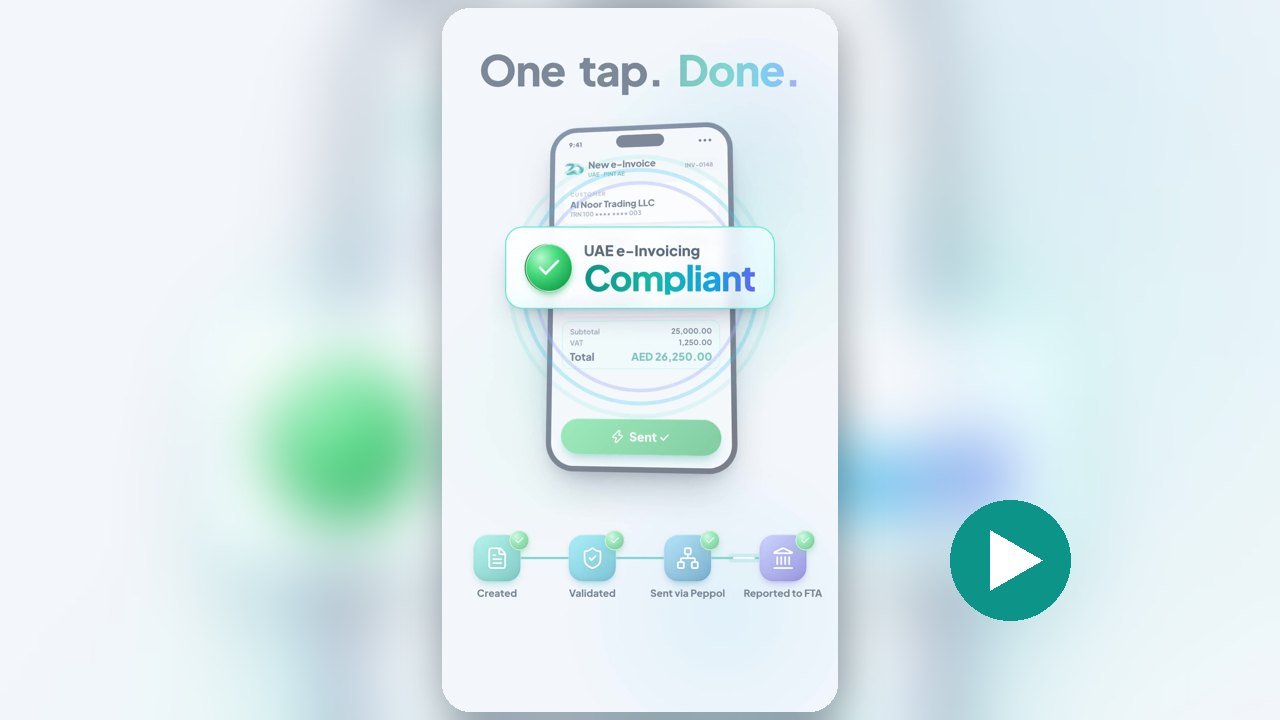
"One tap" e-invoicing sounds like marketing. Behind it is a clear journey every UAE e-invoice follows. Here it is, step by step, in plain English.
E-invoicing is a legal requirement. Done properly, it can also switch your VAT and bookkeeping to autopilot. Here is how one invoice flows through your books, and where people still matter.
Not every business wants to become an e-invoicing expert. Here is exactly what a done-for-you setup covers, what you need to have ready, and how the timeline works against your deadline.

Staff scheduling and shift planning software should let a manager build a rota in minutes, publish it to staff phones, handle swaps and availability, show labour cost against expected demand, and feed attendance and payroll without re-typing.
Read more
Tracking visa, Emirates ID and contract expiry automatically means one document register per employee, alerts to HR and the employee at set intervals before each date, a renewal checklist, and the renewed document uploaded to close the loop.
Read moreAI assistants recommend businesses whose pages they can crawl and quote. Clear headings, a direct answer in the first paragraph, FAQ sections and consistent business details make your site the one they cite.
Read moreDeadlines, how-tos, software, industries, free zones, errors, plus a TRN checker, PINT AE pre-validator and deadline calculator. المكتبة بالعربية
Browse all guides
Answers about Zaini Developers: custom ERP, CRM and POS, mobile apps, UAE and GCC e-invoicing, pricing approach, timelines, demos, languages, support and partne
Read guideA practical guide to custom CRM development for UAE businesses: when a custom CRM beats an off-the-shelf one, must-have features, the build process and UAE e-in
Read guide
How custom ERP development works for UAE businesses: modules, multi-company and free zone setups, VAT and PINT AE e-invoicing, data migration and the build proc
Read guide
One table comparing e-invoicing in the UAE, Saudi Arabia, Oman and Qatar: deadlines, model, format and providers. For businesses selling in more than one GCC co
Read guideFinal go-live checklist for UAE businesses with revenue of AED 50 million or more: what must work on 1 January 2027, updated for Ministerial Decision 197 of 202
Read guideFind out whether UAE e-invoicing applies to your business, which phase you are in and your deadline. Free interactive checker based on Ministerial Decisions 243
Read guideStep-by-step guide to appointing your UAE e-invoicing Accredited Service Provider in EmaraTax: what to prepare, the steps, what happens next and how to switch p
Read guideIf your business has revenue of AED 50 million or more and did not appoint an Accredited Service Provider by 30 October 2026, here is the penalty exposure and a
Read guideThe UAE e-invoice validation errors businesses hit most, with the rule IDs (IBR-132-AE, IBR-190-AE and more), what they mean in plain language and how to fix ea
Read guideMost UAE businesses can keep their software for e-invoicing. Here are the four routes, a simple decision table, and the questions that tell you which applies.
Read guideMainland and free zone companies follow the same UAE e-invoicing rules. The differences are in VAT treatment, transaction flags and data. A side-by-side guide.
Read guidePhase 2 UAE e-invoicing plan for SMEs: appoint an ASP by 31 March 2027, go live 1 July 2027. Month-by-month steps from now until go-live.
Read guideStep-by-step guide to issuing a UAE e-credit note: when you need one, the original invoice reference and reason code, the 14-business-day timeline and the penal
Read guideA code-level guide to making an ERP emit valid PINT AE documents: field mapping, the real AE Schematron rule IDs, ASP API patterns, idempotency and webhooks.
Read moreNone of the three makes you compliant on its own — every one still needs an Accredited Service Provider. Here is where the gap sits, what each costs and who should pick which.
Read moreService businesses hit problems product businesses never see: classification codes, government-fee disbursements, commission splits and retainer periods. Here is what to fix first.
Read moreHow a quote becomes an invoice, a PINT AE document, a ledger entry and a VAT return without manual re-entry — and the seven places the chain usually breaks.
Read moreLeave management for small companies breaks down when requests live in WhatsApp and balances live in someone's head. A simple system with balances, approvals, a team calendar and a payroll link fixes it in about a week.
Read moreThe most common payroll mistakes UAE SMEs make are late or short WPS payments, salary structures that do not match contracts, forgotten deductions, gratuity errors, poor records and no approval step. Each has a straightforward fix.
Read more
HR software for salons, clinics and shops needs to handle shift rotas, commissions and tips, part-time staff, licence and visa expiry, and WPS payroll, all from a phone, because nobody on the shop floor has time for a desktop HR suite.
Read moreAttendance tracking for field staff works when the app is fast on a cheap phone, proves location without draining the battery, survives bad signal, and posts hours straight to payroll. Anything else gets abandoned within a month.
Read moreEnd-of-service gratuity in the UAE is calculated from the employee's basic wage and completed service, with rules that depend on how the employment ended. Software that accrues it every month gives you an accurate liability and a dispute-free final settlement.
Read moreAn employee self-service portal lets staff view payslips, check leave balances, request time off, update details and download letters without asking HR. The result is fewer interruptions, cleaner data and employees who feel trusted.
Read moreMost shops and restaurants need an 80 mm thermal receipt printer, a 2D barcode scanner, a printer-driven cash drawer and a tablet or small PC. This guide explains each component, how they connect and what to budget, so you buy once.
Read moreFrom 1 June 2026, Ministerial Resolution No. 340 of 2026 governs the UAE Wage Protection System. Salaries are due on the 1st of the following month, the compliance threshold is now 85%, and penalties escalate from day 2 onwards.
Read moreGood HR and payroll software for UAE companies holds the employee master, attendance, leave, salary structures and WPS output in one place, so month-end is a report rather than a rebuild. Here is what to look for and what to avoid.
Read moreA supermarket or grocery POS in the UAE must handle fast scanning, weighing-scale items, expiry-tracked batches, multi-buy promotions and VAT-correct receipts across several tills. This guide lists the features that matter and the questions to ask.
Read more
QR menu ordering lets guests scan a code, browse your menu in their language and order or pay from their phone. Done right it cuts waiting and errors; done badly it frustrates guests. Here is the setup, the costs and the traps.
Read moreSeven POS reports, ten minutes each morning: daily sales summary, cash and card reconciliation, sales by hour, item performance, voids and discounts by staff, low-stock and variance, and the VAT summary. Here is what each one tells you and what to do about it.
Read moreCafés need a fast counter, clean modifiers and a loyalty hook; cloud kitchens need one screen for every delivery channel and tight ingredient control. Here is the short list of what matters and what you can safely skip.
Read moreStock loss shrinks when every movement is recorded, every adjustment needs a reason and a permission, and variance is reviewed weekly. A modern POS gives you those controls; this article shows how to switch them on.
Read moreA POS with a built-in loyalty programme lets you reward repeat customers by phone number at the till, without a separate app. Here is how to pick points, stamps or cashback, set the rules, and measure whether it is working.
Read moreA restaurant POS in Dubai earns its keep through kitchen tickets, recipe-level inventory, controlled voids and VAT-correct receipts. Here is which features actually save money and how to test them in 30 minutes.
Read moreA retail POS in the UAE needs three things done properly: VAT-correct receipts with your TRN, barcode-driven stock that stays accurate, and reports you actually read. Here is what to check before you buy.
Read more
Cloud POS wins on upfront cost, remote reporting and updates; traditional on-premise POS wins on independence from the internet and from monthly fees. The right choice depends on your outlets, connectivity and how much control you want.
Read moreA good software maintenance contract covers security updates, backups, bug fixes, regulatory changes such as UAE e-invoicing, defined response times and clear exit terms. It should name what is included, what costs extra and who owns the code.
Read moreInventory management software for a UAE small business should track stock across locations in real time, link every sale and purchase to stock levels, warn before you run out and feed VAT-compliant invoices. Here is how to choose it.
Read moreAgencies and studios need project management software that links each job to its quote, tasks, time, client approvals and final invoice, so unbilled hours and scope creep become visible instead of silently eating the margin.
Read moreMost ERP implementations fail for people reasons, not software reasons: no internal owner, dirty data, copying old spreadsheets into new screens, skipping training and launching everything at once. Each one has a simple fix.
Read moreWhite-label software is a finished product you rebrand and sell as your own, with the original developer maintaining it behind the scenes. For UAE resellers it is the fastest way to launch a branded ERP, CRM or POS without building one.
Read moreMulti-tenant SaaS means one software platform serves many customer companies at once, each seeing only its own data. It is how most cloud business software works, and the key questions are how data is separated and where it is stored.
Read moreYour business has outgrown Excel when two people cannot edit the same file safely, stock numbers never match the shelf, month-end takes days, nobody trusts the totals and VAT or e-invoicing reporting is done by hand.
Read moreA trading company ERP keeps stock, purchases, sales invoices and VAT in one database, so every sale updates inventory and the VAT return at once. In the UAE it should also be ready for PINT AE e-invoicing by July 2027.
Read moreA business website typically takes 2 to 6 weeks, a CRM or POS 6 to 12 weeks, and a full ERP 3 to 9 months. The biggest variable is not coding but how quickly decisions and data arrive from your side.
Read moreA client portal gives each client a secure login to see their files, upload documents, approve quotations and track every application. It cuts status calls, speeds up document collection and makes your consultancy look larger than it is.
Read moreA safe CRM data migration follows six steps: back up everything, clean and deduplicate, map every field, import in test then live, validate counts and samples, and cut over with a short parallel run and a rollback plan.
Read moreOff-the-shelf software wins when your process is standard and you need it this week. Custom software wins when your workflow is your edge, you have several branches or you need UAE-specific compliance built in.
Read moreThe cleanest quotation to invoice workflow generates each document from the previous one: quotation, acceptance, proforma, tax invoice, payment and receipt, so nothing is retyped and VAT, TRN and numbering are always right.
Read moreExcel is fine for one person tracking a few leads. When several people edit the same file, follow-ups get missed and nobody trusts the numbers, a CRM pays for itself quickly. Here are the seven signs to watch for.
Read moreOne CRM can serve a UAE office and an Indian office if it separates what must stay separate (legal entity, currency, tax rules, invoice numbering, data location) and shares what should be shared: clients, pipeline, staff and reports.
Read moreConnecting WhatsApp to your CRM means every incoming chat becomes a lead record with an owner, a stage and a follow-up date, so enquiries stop disappearing in personal phones when staff are busy or leave.
Read moreConsultancies lose most deals to silence, not to price. A lead follow-up system fixes that with a defined sequence of touches, a clear owner for every lead and a CRM that makes the next action impossible to forget.
Read moreA custom CRM in Dubai is priced by scope, not by seat. Typical market ranges start in the tens of thousands of dirhams for a focused system and rise with integrations, portals, multi-branch needs and automation.
Read moreAccording to the UAE Ministry of Economy, SMEs make up 95% of companies, employ 86% of the private-sector workforce and generate 63.5% of GDP. The common thread is that these businesses now face the same compliance and technology demands as large firms.
Read moreThe best CRM for a UAE business setup consultancy follows the whole client journey, from enquiry and quotation to licence, visas and yearly renewals, instead of stopping at the point a deal is won.
Read moreA CRM for PRO services is really an expiry engine: every visa, Emirates ID, trade licence and contract has a date, and the system should warn you 90, 60 and 30 days ahead and turn each one into a job.
Read moreA full tax invoice carries the customer's details and line-level VAT; a simplified tax invoice drops those for small consumer sales but must still show your TRN, the date, a description and the VAT amount. Your software should choose the right one automatically.
Read more2027 is the year UAE e-invoicing becomes mandatory: 1 January for revenue of AED 50 million or more, 1 July for everyone else, 1 October for government entities. Add VAT, wage and corporate tax deadlines and you have your compliance calendar.
Read moreTo automate VAT calculations, set up tax codes once, calculate VAT per line at 5%, round consistently, link credit notes to invoices and let the system produce the VAT return. Staff should never type a VAT amount by hand.
Read moreCorporate-tax ready accounting software tracks revenue and profit by tax period, separates entities, keeps an audit trail for generally 5 years, handles VAT alongside corporate tax and is ready for PINT AE e-invoicing in 2027.
Read moreTo file VAT returns on EmaraTax smoothly, your software must produce output VAT, input VAT and adjustments per tax period, reconcile to your bank and keep every tax invoice. Here is the checklist we use before every filing.
Read moreUAE businesses must keep tax records for generally 5 years, and under e-invoicing rules electronic documents must be stored inside the UAE. Digital records are allowed and encouraged, provided they are complete, unaltered and retrievable.
Read moreA UAE tax invoice must show the words Tax Invoice, your TRN, a sequential number, the date, a description, the net amount, the 5% VAT in AED and the total. Here is the full list and how e-invoicing changes it.
Read moreYou must register for UAE VAT once taxable supplies exceed AED 375,000 in the past 12 months or are expected to in the next 30 days. Voluntary registration starts at AED 187,500. Late registration costs AED 10,000.
Read moreSmall Business Relief lets a UAE business with revenue of AED 3 million or less be treated as having no taxable income for the period. It must be elected in the return and now runs for tax periods ending on or before 31 December 2029.
Read moreUAE e-invoicing starts with a pilot on 1 July 2026 and becomes mandatory from 1 January 2027 for larger businesses and 1 July 2027 for everyone else. Here is what every business owner needs to know.
Read moreBusinesses with revenue of AED 50 million or more must comply from 1 January 2027; all other businesses from 1 July 2027; government entities from 1 October 2027. The pilot opens on 1 July 2026.
Read morePINT AE is the UAE profile of the Peppol International Invoice format. Every e-invoice and e-credit note exchanged through an Accredited Service Provider must follow it, and your ASP will reject documents that do not.
Read moreEvery UAE business in scope must appoint an Accredited Service Provider before its e-invoicing deadline. Choose one on integration fit, UAE data storage, support quality and transparent pricing, not on the first offer you receive.
Read moreCabinet Decision No. 106 of 2025 sets five e-invoicing penalties: AED 5,000 per month for not implementing the system or appointing an ASP, AED 100 per late e-invoice or e-credit note (max AED 5,000 a month), and AED 1,000 per day for unreported failures or data changes.
Read moreSmall businesses in the UAE have until 1 July 2027 to issue e-invoices through an Accredited Service Provider. This checklist covers the ten steps to get there without hiring a compliance department.
Read moreA PDF invoice is a document a human reads; a UAE e-invoice is structured PINT AE data validated by an Accredited Service Provider, delivered to your customer and reported to the FTA. From 2027 only the second one counts.
Read moreConnecting a CRM or ERP to UAE e-invoicing means mapping your invoice data to PINT AE, building a secure link to your Accredited Service Provider, and adding a workflow for rejections, credit notes and alerts. Here is how the project runs.
Read moreUnder UAE e-invoicing, a credit note is a structured e-credit note that references the original e-invoice and travels through your ASP like an invoice. Late or missing e-credit notes cost AED 100 each, capped at AED 5,000 per month.
Read moreFree zone companies are not excluded from UAE e-invoicing. If you carry out commercial transactions in the UAE, your deadline is 1 January 2027 at AED 50 million revenue or more, or 1 July 2027 below that, and you must appoint an ASP like any mainland business.
Read moreVAT invoices, split payments, multi-branch stock, offline mode and e-invoicing readiness — the checklist for picking a POS in the UAE.
Read moreFrom hPanel to a live ERP: database, subdomain, SSL, cron jobs, backups and the settings that keep a PHP app fast on shared hosting.
Read moreWhere AI actually saves time for SMEs in 2026: WhatsApp assistants, document processing, forecasting and smart CRM follow-ups — and where it doesn't.
Read moreA step-by-step guide to company formation in the UAE in 2026 — Mainland, Free Zone and Offshore options, requirements, costs, timelines and the software you'll need from day one.
Read morePerformance budgets, programmatic SEO, multilingual-by-default and AI assistants on the page — the web trends that matter for business websites this year.
Read moreSpreadsheets break at scale. Here's how a custom ERP connects sales, inventory, accounting and payroll — and when a white-label ERP is the smarter buy.
Read moreNewsletter
Guides and updates on UAE business, technology and digital solutions.